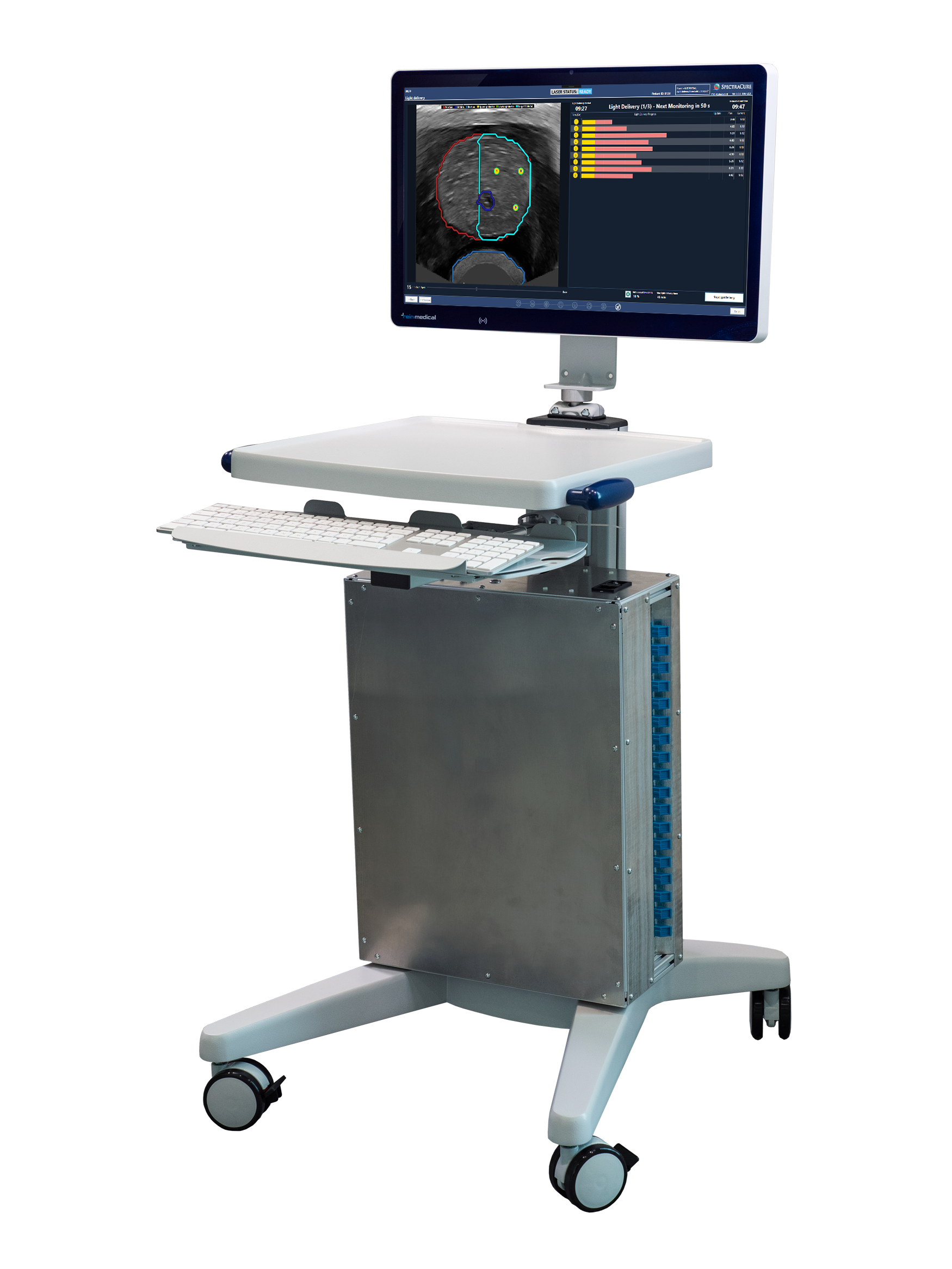
The patented and in-house developed Q-PRO® system represents a new treatment for prostate cancer. The goal is to meet the market’s growing need for individualised and effective treatments for patients with prostate cancer.
Maintained quality of life
Potential to give patients the opportunity to maintain a higher quality of life compared to the conventional treatments of prostate cancer.
Individual treatment
A unique treatment with PDT, which has the potential to tailor the procedure to the specific individual and allow treatment regardless of the tumour’s position in the prostate.
Focal treatment
Potential to provide a highly precise and targeted treatment, offering a minimally invasive solution for prostate cancer.
Q-PRO® enables improved treatment for prostate cancer
Our treatment system Q-PRO® represents a completely new treatment for prostate cancer consisting of:
a laser device that delivers laser light through optical fibers, which both processes and monitors the delivered light dose,
the IDOSE® software platform, which calculates the optimal laser light dose and placement of the optical fibers,
disposable items consisting of, among other things, needles, optical fibers and light-sensitive drug.
“The SpectraCure IDOSE® system is an exciting new approach for estimating the extent of necrosis during PDT, based on real time measurements of light distribution and photobleaching in the area under treatment”
Stephen G Bown, MD (Cambridge), AM (Harvard), DSc (Hon Lucknow), FRCP Emeritus Prof of Laser Medicine & Surgery, Division of Surgery & Interventional Science
Treatment with SpectraCure’s Q-PRO®
The treatment system Q-PRO® delivers laser light via optical fibers that are inserted into the prostate after the drug verteporfin has been injected. Verteporfin has been used for many years to treat certain serious eye diseases. The system uses the same optical fibers to both treat the tumour area and monitor the delivered light dose. The proprietary dose planning platform, IDOSE®, adjusts the optimal treatment dose for each patient, with great accuracy, to avoid over- or under-exposure. Because overexposure to light can lead to damage to healthy tissue and underexposure can lead to incomplete treatment and tumour recurrence.